Invisible Chronic Illness and Neurodivergence

It’s not all in your head.
If you live with invisible chronic illness and/or highly masked Autism, ADHD, or High Sensitivity, your reality has likely been questioned, dismissed, our denied for most of your life. While living with a visible disability undoubtedly comes with its own set of challenges, when illness and differences are invisible to others, over time their denial can cause us to question our own reality.
“You’re so sensitive!”
“But you don’t look sick!”
“Get over it already, life is hard.”
“What if this is just in your head? I mean, we’re all tired.”
“You’re just saying that to get out of this thing/get attention.”
“Have you tried [insert supplement, meditation, journaling, exercise, etc.]?”
Turns into:
“I guess everyone feels this way, and I’m just weak for not being able to handle it.”
“I just need to try harder, if I do/find the right thing I’ll feel better/be fixed.”
“I just need to get over it and learn to push through.”
“What if I am just making all of this up?”
“What’s wrong with me?”
A difference denied becomes a difference masked
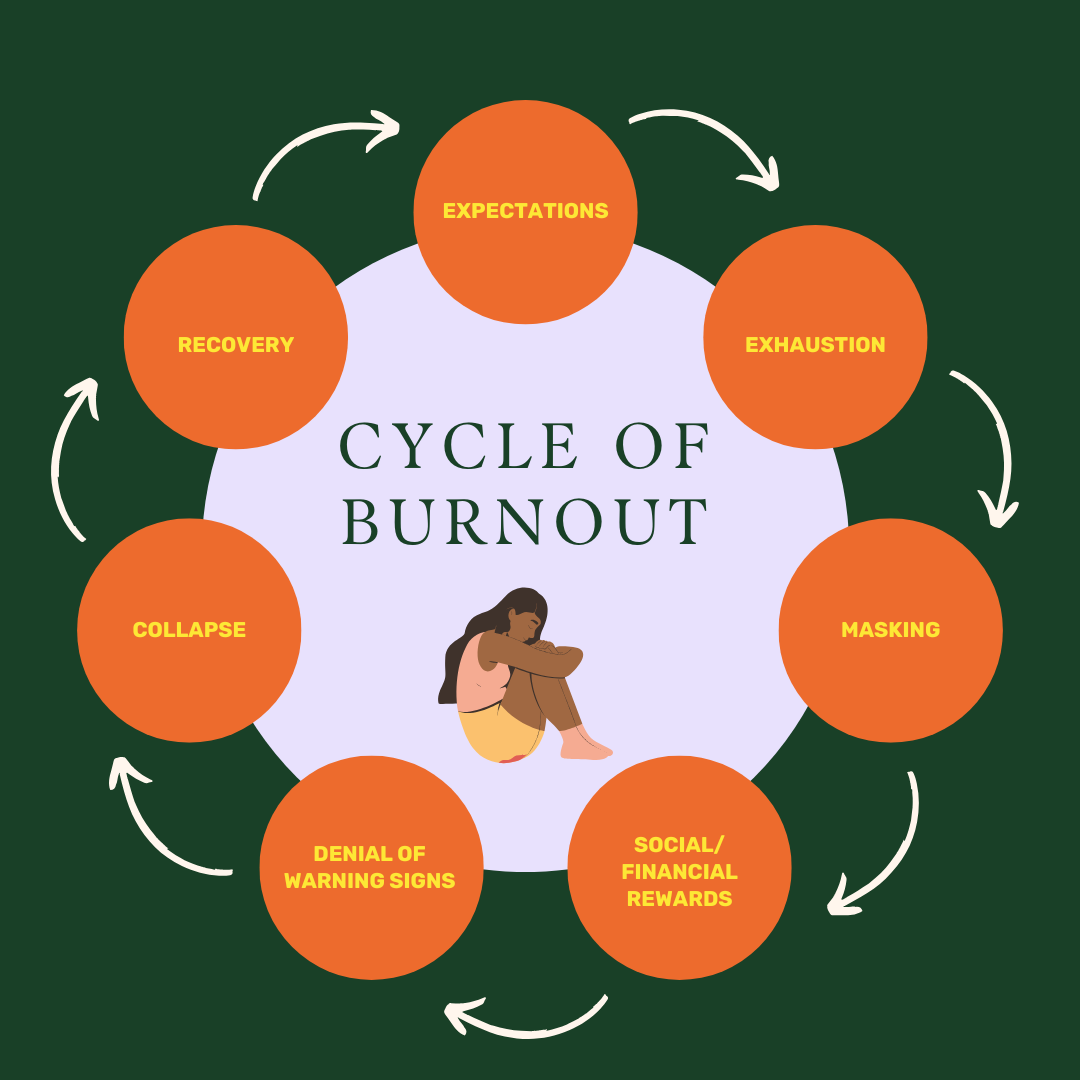
Those of us whose lived experience places us in these liminal spaces of invisible illness and divergence are often highly accomplished at masking. After years of having our pain, struggles, and differences denied, dismissed, or even ridiculed, we’ve learned to live behind masks made to protect ourselves from further rejection and shame. These masks are made up of strategies designed to cover up our perceived short-comings, most common among them perfectionism and people-pleasing (a.k.a. the fawn stress response). These strategies are highly effective in making us seem palatable, likable, and hard working, thus initially serving their purpose well.
But, upholding these masks longterm comes at a significant and often detrimental cost. As we are forced to become complicit in the denial of our true reality in order to ensure belonging and safety, our systems start to sound the alarm via a justified stress response of anxiety, overwhelm, or dissociation (flight), frustration (fight), and depression (freeze). And underneath it all sits that deep and constant sense of shame about who we ‘really’ are beneath the mask.
As you probably know, sooner or later this becomes impossible to sustain. Living in survival mode is incredibly taxing on our entire system, but often it’s the body that surrenders first - we get sick, injured, or our chronic illness flares up, causing the masks to crack and pulling us into the depths of burnout (shut down). Confronted yet again with the harsh reality of our perceived shortcomings, and fueled by the guilt of letting everyone down AGAIN, we invest precious resources into recovering just enough to function again, only to start the whole cycle all over again.
Side note: this is why we don’t use the term high functioning when talking about the experiences of Autistic folks who exist in this liminal space. That term is steeped in ableism and capitalism, and the question we have to ask is what is it costing that person to function this way?
The correct terminology is based on support needs, which will vary depending on both internal and external factors.
It took me over a decade of surfing the waves of this cycle, crashing into burnout over and over again, until I was able to recognize the ocean in which I was trying to keep my head above water. Now, looking back, I can give myself grace, because after all it’s the water we’ve all been swimming in for generations. Capitalist society is full of subliminal and overt messaging that supports this cycle, and induces deep guilt and shame, and a feeling of defectiveness, in folks who’s bodies and brains are just built different.
But we are humans, not machines. And there is will inevitably be a mismatch between our needs as human beings, and the expectations placed upon us by a toxic system that socializes us to believe that our worth depends on our ability to function, and to reject those who do not fit the working standard of performance and productivity. Some of us might become aware of this mismatch sooner than others, simply because it affects us more significantly (think canary in the coalmine), but that doesn’t mean it’s not harming us all. The cage that keeps us trapped in this cycle is made up of (internalized) ableism and shame, and until we dismantle it we will continue to suffer.
So how to we start to break down those walls?
Acceptance
We begin by acknowledging that we cannot go on this way. We have to accept that we were (unintentionally) harmed by those who denied our reality, and we have to accept that we are actively harming ourselves by continuing to do the same.
Gaining Perspective
“But almost always, during the initial stage of the struggle, the oppressed, instead of striving for liberation, tend themselves to become oppressors, or ‘sub-oppressors’.” - Paolo Freire
As long as we continue to buy into the notion that our differences mean we are somehow inherently wrong or broken and in need of fixing, we are funneling our precious resources into sustaining oppressive systems, and continue to harm ourselves and others in the process. We have to recognize that in this case the guilt and shame we feel are conditions of oppression, not reflections of reality.
Re-connecting with Your Truth
What’s true for me right now is: _____________________________________________. Can you answer this question honestly?
Allowing ourselves to re-connect with our own reality after spending years avoiding, masking, and dissociating from it can feel incredibly foreign, confronting, and scary. What am I going to find if I dare to turn inward? What will happen if I own everything that’s alive in me? Where does the mask end and my true self begin? Who even am I beneath the mask? As we begin to explore these questions and allow answers to arise, we are able to integrate what happened to us and how we survived with who we are. In time, a congruent sense of self begins to emerge - one that is rooted in our individual lived experience and affirmed by our collective shared reality, but that does not require another’s understanding or permission to exist.
Creating our own reality
The dismantling of oppressive cages happens brick by brick, moment by moment, choice by choice. While we didn’t chose to be born with a divergent mind and/or chronic illness, when we own this as part of our truth we reclaim our agency, and it is our birth-right to exercise that in service to creating a life for ourselves that supports our differences and celebrates our strengths. In freeing yourself, you give others permission to be free, too.
A reminder from me to you, and to me.
I hear you. I see you. I believe you.
Next time you catch yourself getting pulled back into the pressure to function, to shrink and mask yourself for safety and belonging - pause - and ask yourself: is this necessary for my survival in this moment? If the answer is yes, proceed while giving yourself permission to look for the nearest exit. If the answer is no, allow your breath to deepen and your chest to expand, and remember that you are good, in this moment, just as you are.
And when your body, mind, and spirit inevitably remind you of your humanity, meet yourself with compassion and ask yourself: what’s the kindest thing I can do for myself right now?
With love,
CP
Recommended Reading:
Pedagogy of the Oppressed by Paolo Freire (1968): https://la.utexas.edu/users/hcleaver/330T/350kPEEFreireCh01table.pdf
Rethinking disability: the social model of disability and chronic disease by Sara Goering (2015): https://pmc.ncbi.nlm.nih.gov/articles/PMC4596173/
The Curb-Cut Effect by Angela Glover Blackwell (2017): https://ssir.org/articles/entry/the_curb_cut_effect